
Legal Requirements for Fire-Alarm Testing in the UK
False confidence is deadly. UK legislation demands that every commercial and residential building with a fire-alarm system tests it regularly and records the results. Below is the plain-English rundown of what the law—and its supporting standards—actually require.
📞 Call 01438 735777

1. The legal backbone
Regulatory Reform (Fire Safety) Order 2005
Article 17 obliges the “Responsible Person” to keep fire-protection systems in “efficient working order” and maintain proof.
Fire Safety Act 2021
Extends that duty to the fabric, external walls and any parts of the structure containing a fire-alarm interface.
Fire Safety (England) Regulations 2022
For multi-occupied residential buildings over 11 m, Regulation 8 reinforces the need for evidenced maintenance of all life-safety systems, including alarms.
Failing to comply can trigger Enforcement Notices, fines or prosecution.
2. The technical benchmark: BS 5839-1
While not legislation, BS 5839-1 is cited by courts and insurers as the proof of “efficient working order.” It demands:
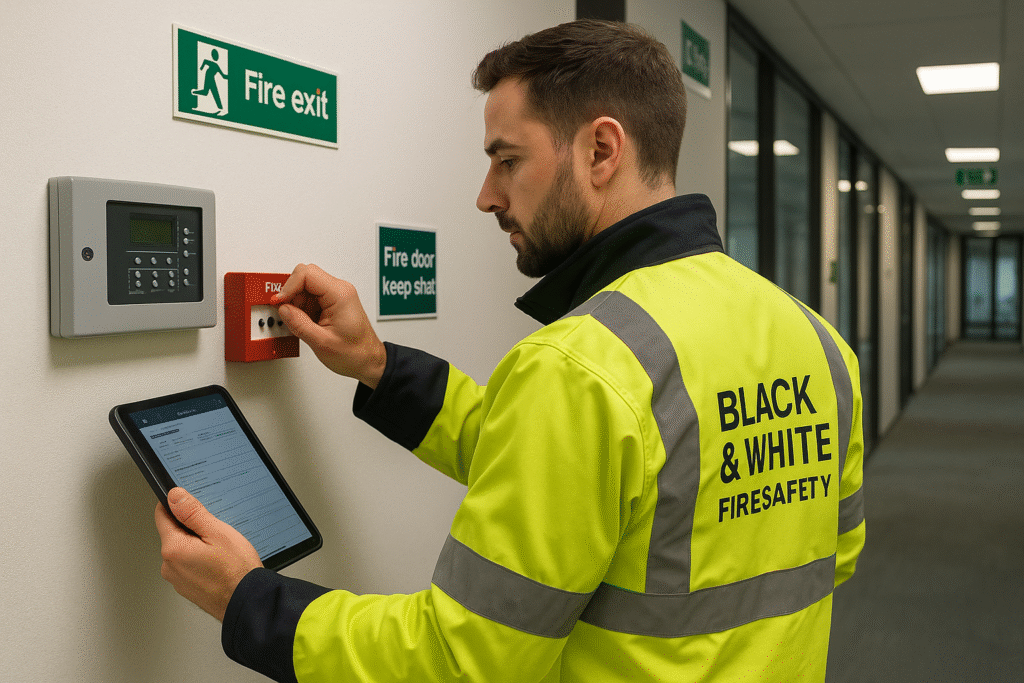
Weekly user test – activate at least one manual call-point on a rota, confirm sounders and strobes work, then log the result.
Six-monthly competent-person service – a qualified engineer inspects, tests and certifies the system; larger or high-risk sites may need quarterly visits.
Device coverage over two visits – at each six-month service, test roughly 50 % of detectors and interfaces, so all devices are proven annually.
Logbook evidence – paper or digital; must be produced for the Fire & Rescue Service or insurers.
3. Supporting standards you might meet
BS 5839-6 – specific clauses for fire-alarm systems in HMOs and domestic premises.
BS 5839-8 – voice-alarm testing (PA/VA) in public venues.
BS 7273-4 – checks on door-release interfaces linked to the alarm panel.
BS 9999 – holistic fire-safety management for complex buildings; adopts BS 5839-1 testing regime.
4. Your minimum testing timetable
Every week – user call-point test, panel reset, log entry.
Every six months – engineer service: loop readings, battery impedance, detector cleaning, cause-and-effect verification.
Every year – full device coverage, sound-pressure survey, record update.
Immediately after false alarms, system faults or building alterations – ad-hoc tests to re-establish compliance.
5. Penalties for non-compliance
Enforcement or Prohibition Notice from the local Fire & Rescue Service.
Insurance claim reductions or refusal to pay after a loss.
Criminal charges under the Fire Safety Order if negligence leads to injury.
6. Frequently asked questions
Is BS 5839-1 legally binding?
Not by statute, but it is the recognised code of practice. Deviating without justification risks legal action.
Can my maintenance staff do the six-monthly service?
Only if they hold demonstrable competence—usually third-party certification such as BAFE SP203-1.
Do addressable systems need more frequent tests?
The same weekly and six-monthly regime applies, but firmware updates and battery checks are critical—insurers increasingly ask for proof.
What counts as a “record”?
Paper logbooks are acceptable; a cloud logbook is better. The key is that entries are dated, signed and retrievable on demand.
Client Testimonials
Posted on GoogleTrustindex verifies that the original source of the review is Google. Black & White have given us full support in our new building, from Fire Risk Assessment, to upgrade of fire extinguishers, fire marshal training to installation of a fully compliant fire alarm system, to mean we are fully compliant and ensuring the safety of our staff. Thank you.Posted on GoogleTrustindex verifies that the original source of the review is Google. I would like to kindly provide a lovely review of the recent fire maintenance engineer, Adam I believe who carried out the fire prevention visit last week. Throughout the visit, he was an absolute pleasure to work with, and I learned a great deal about safety from him. He was welcoming, polite, efficient, professional, and approachable. He brought many important details to my attention and identified areas that needed further investigation. His thoroughness and dedication were very impressive, and I am confident in his ability to maintain the block effectively. I sincerely hope this message reaches him.Posted on GoogleTrustindex verifies that the original source of the review is Google. We have worked with Black & White for a number of years now and have a strong working relationship. B&W have continuously demonstrated strong technical knowledge and assisted our team on multiple occasions; from detailed surveying, to prompt and diligent servicing, or competitive priced thorough major projects delivery they continue to deliver a very high standard of services for Neil Douglas. Looking forward to many more years of working together.Posted on GoogleTrustindex verifies that the original source of the review is Google. I have worked closely with Black and White Fire and Security for the past 10 years at The Saint John Henry Newman school , they have always provided an outstanding service of both fire alarm systems and fire extinguishers. They have helped out greatly during the redevelopment of the site. Would highly recommend.Posted on GoogleTrustindex verifies that the original source of the review is Google. Carried out a fire risk assessment for our block of flats. Report was very detailed and turned around quickly to help facilitate a sale of one of the flats. Would recommend.Posted on GoogleTrustindex verifies that the original source of the review is Google. Black and White Fire have been servicing, maintaining, and managing our company’s fire safety for as long as I can remember. They’re professional, very easy to deal with, and have always been open and honest. A first-class company that we trust and highly recommend. 🔥Posted on GoogleTrustindex verifies that the original source of the review is Google. I recently used Black & White Fire Safety Ltd for a fire risk assessment and extinguisher maintenance. Their team was professional, thorough, and explained everything clearly. The service was excellent, and I’d highly recommend them for reliable fire safety support.